Why Cloud Cover Isn’t Enough for Stargazing
A weather forecast tells you how cloudy it is. For astronomy, you need to know where the cloud is.
The Problem with a Single Cloud Percentage
A weather forecast might say 30% cloud. That’s useful if you’re deciding whether to take an umbrella. For astronomy, it leaves out something important: where is the cloud?
If Jupiter is 15° above the southern horizon, it doesn’t matter very much that the sky directly overhead is perfectly clear. What matters is whether there is cloud between you and Jupiter.
Most weather forecasts describe cloud cover at your location. For many purposes that’s exactly what you want. It is also a useful starting point for a stargazing forecast, and ClearSkys uses cloud cover extensively when assessing the overall quality of a night.
But the lower an astronomical object is in the sky, the less representative the cloud directly above you becomes.
Imagine you’re standing under clear sky while a bank of low cloud approaches from the west. Saturn is also low in the west. The weather at your exact location is still clear while the cloud bank is sitting directly between you and Saturn. For an observer, Saturn is cloudy.
That distinction matters particularly for objects near the horizon: a rising or setting Moon, planets, satellites, eclipses and other events where you cannot simply wait for the target to move somewhere else in the sky.
Following the Line of Sight
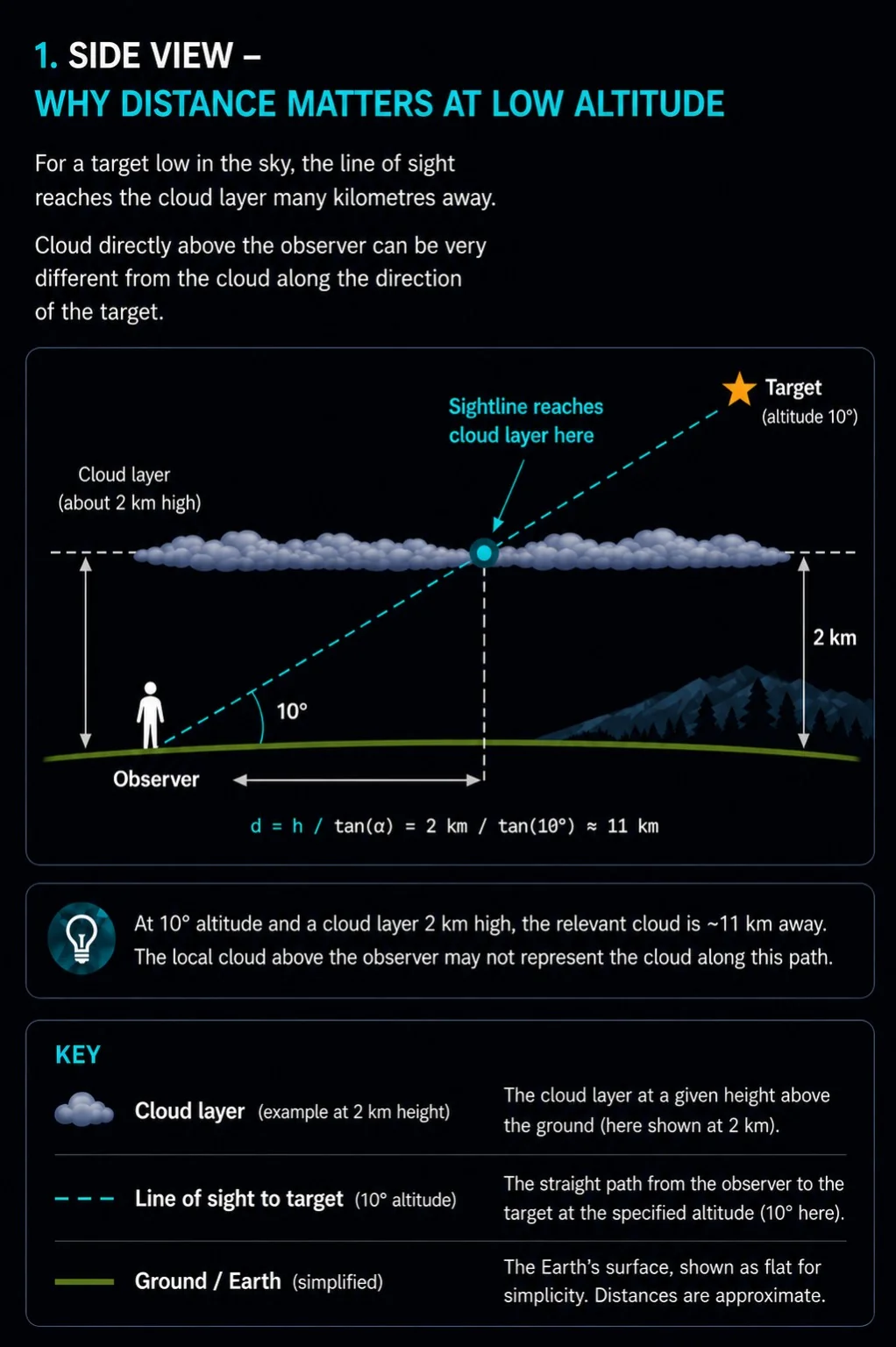
The basic geometry is surprisingly simple. Imagine an astronomical object at altitude α above the horizon and a cloud layer at height h. The observer’s line of sight reaches that cloud height some distance away.
Ignoring the curvature of the Earth for this simplified explanation, that horizontal distance is approximately:
d = h / tan(α)
where d is the horizontal distance from the observer, h is the height of the cloud layer, and α is the altitude of the astronomical target.
This immediately explains why low objects are difficult. Suppose a cloud layer is 2 km above the ground. If the target is 45° high, the sightline reaches 2 km altitude only about 2 km away. At 20°, it is roughly 5.5 km away. At 10°, it is roughly 11 km away. At 5°, it is roughly 23 km away.
So when you’re looking at an object only a few degrees above the horizon, the relevant cloud may be tens of kilometres away from where you’re standing. A weather observation for your exact location cannot fully describe that.
Direction Matters Too
Distance is only half of the problem. We also know the object’s azimuth — its compass direction.
That gives us both pieces needed to ask a better question: what cloud is forecast at the point where my sightline towards this object passes through the cloud layer?
ClearSkys can project that point away from the observer along the target’s bearing and sample gridded weather forecast data there. It does this separately for different cloud layers.
Instead of asking only “how cloudy is my location?”, we can start asking “how cloudy is the atmosphere I’m actually looking through?”.
From Individual Probes to a Directional Cloud Field
The first version of this idea was straightforward: for each target, calculate the appropriate points along its sightline and request the weather forecast at those locations. That works, but it scales badly.
A single planet is easy. A night’s observing forecast can contain several planets, the Moon, an eclipse or other event, and multiple satellite passes. A satellite moves across the sky, so even one pass can involve several interesting positions. Fetching a new weather forecast for every target and every position would create a large number of requests.
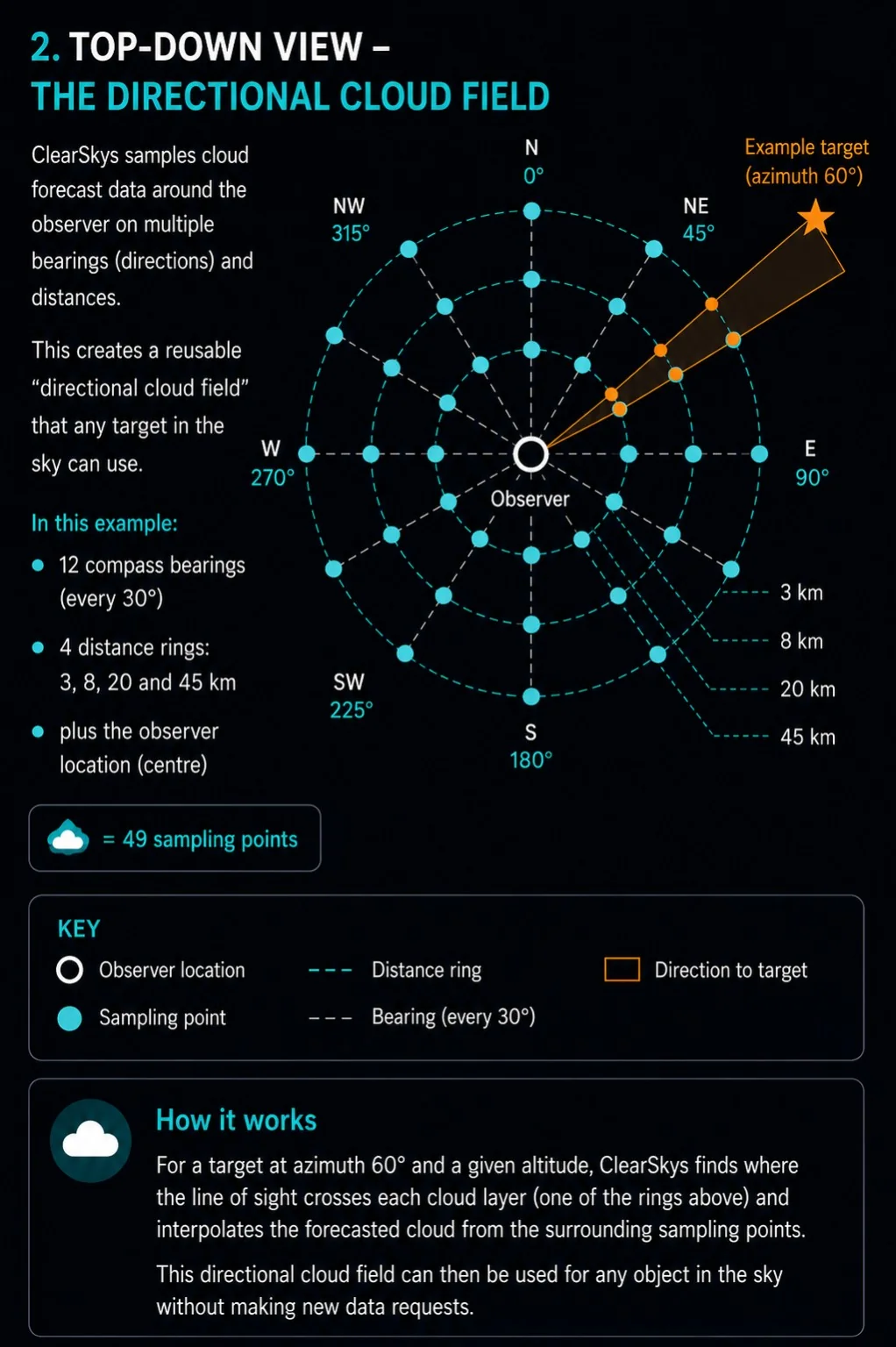
ClearSkys therefore approaches the problem in reverse. Instead of building a weather query for every astronomical object, it builds a reusable directional cloud field around the observer.
The field samples multiple compass bearings and multiple distances from the observer. Currently that means 12 bearings and four distance rings — approximately 3, 8, 20 and 45 km — plus the observer’s own location. That produces 49 sampling points.
The hourly low-, mid- and high-level cloud forecasts for those points can be fetched together and cached. Once the field exists, every astronomical target can use it.
Given a target’s altitude and azimuth, ClearSkys calculates where its sightline crosses each cloud layer and interpolates the cloud forecast from the surrounding points in the field. The interpolation is performed across bearing and distance. Distance is treated logarithmically because sightline distances grow rapidly as an object approaches the horizon.
The same weather field can therefore serve the Moon, planets and multiple satellite passes without fetching another forecast for every object.
An Example
Consider a planet 10° above the western horizon. The normal forecast at the observer might report relatively little low cloud.
But the directional calculation tells us that the relevant portion of a low cloud layer lies several kilometres west of the observer. If the gridded forecast shows a bank of low cloud there, ClearSkys can flag poorer conditions towards the planet even though the observer’s local cloud value still looks good.
Conversely, the opposite can happen. Cloud somewhere else in the forecast area can contribute to an unattractive overall cloud percentage while the particular direction containing the object remains relatively clear.
Directional forecasting doesn’t replace the normal cloud forecast. It answers a different question.
Why This Isn’t Magic
There are important limitations.
Weather models do not know the exact position of every cloud. A gridded cloud forecast is still a model prediction with finite spatial and temporal resolution.
Cloud-layer categories are also broad representations of a complicated three-dimensional atmosphere. The calculation assumes representative heights for the cloud layers. Actual cloud bases and tops vary.
Forecast errors also become increasingly important with distance. For an object very close to the horizon, the relevant atmosphere may be a long way from the observer.
Terrain, very local cloud formation and rapidly developing weather can all produce conditions that a forecast grid does not resolve. And interpolation cannot create detail that isn’t present in the underlying weather model.
For those reasons, ClearSkys does not present directional cloud as knowledge of exactly where every cloud will be. It is an attempt to make better use of the spatial information already available in weather forecast models.
See our verified forecast accuracy →Why Bother?
Because astronomy is directional.
A conventional weather forecast is primarily concerned with conditions at a place. An astronomical observation involves a place, a direction, an altitude and a time. Once we know all four, throwing away the direction and altitude seems wasteful.
For an object high overhead, this often makes little difference. The relevant atmosphere is close to the observer and the ordinary local forecast is generally a reasonable representation. As the target approaches the horizon, however, geometry matters more and more.
That is where directional cloud forecasting becomes useful. It doesn’t make weather forecasting certain. It simply asks a more appropriate question: not just “will it be cloudy tonight?” but “will there be cloud where I’m actually looking?”.
Frequently Asked Questions
What is directional cloud forecasting?∨
Why does direction matter for stargazing?∨
How does ClearSkys build the directional cloud field?∨
How accurate is directional cloud forecasting?∨
Which targets benefit most from directional forecasting?∨
Check tonight's stargazing conditions for any location worldwide.
Search your location →